
Sparring 101: When to Start, What to Expect, and How to Stay Safe
Key Takeaways:
- Most beginners in MMA, Muay Thai, and BJJ are ready for some form of light partner work within 2–4 months of consistent training, but the timeline varies by discipline and individual readiness.
- Sparring at Arizona Combat Sports is structured, coached, and gear-mandatory — it is not the chaotic free-for-all that keeps many beginners up at night.
- You are never required to spar before you feel ready; talk to your coach, and read this guide to understand exactly what the progression looks like.
Most beginners are ready for some form of light partner work within 2–4 months of consistent training. The exact timeline depends on the discipline: BJJ rolling typically comes first, Muay Thai partner drills follow, and structured MMA sparring rounds come last. No reputable gym — including Arizona Combat Sports — throws a brand-new student into the deep end unprepared.
That said, the anxiety is real. You have been drilling, watching, and sweating through fundamentals for weeks, and somewhere in the back of your head is a nagging question: “When are they going to make me fight someone?” This guide answers that honestly — discipline by discipline, step by step.
What Sparring Actually Is (and What It Isn’t)
Sparring is a controlled training exercise, not a fight. Both partners are trying to learn, not win. The moment it becomes a competition of egos, the training value drops for everyone involved.
The word means different things depending on what you are training:
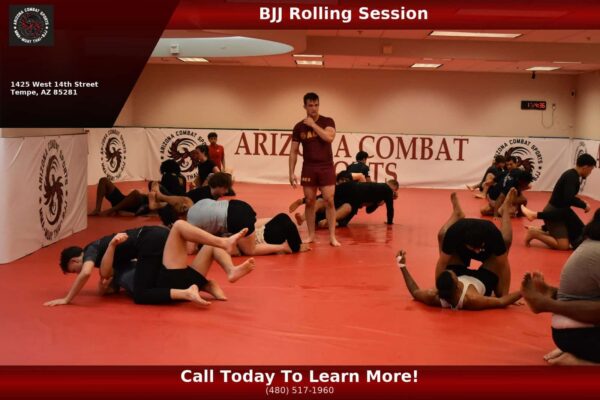
- In BJJ, it is called “rolling” — live grappling from a standing or ground position, with tapping to signal submission.
- In Muay Thai and kickboxing, it ranges from technical partner drilling to light-contact rounds with gloves and shin guards.
- In MMA, it combines both grappling and striking in structured rounds with full protective gear.
None of these are secret rites of passage. They are teaching tools, and they work best when intensity is managed deliberately.
BJJ Rolling for Beginners: The Most Approachable Starting Point
BJJ rolling often starts earlier than striking-based sparring, and there is a structural reason for that. When a technique fails in grappling, the consequence is usually just a bad position, not a shot to the face. The tap is your emergency brake, and at Arizona Combat Sports, the culture around tapping is direct: tap early, tap often, tap before anything hurts.
New grapplers typically begin rolling in a very specific sequence:
- Positional rolling — both partners start from a defined position (guard, side control, mount) and work to improve or escape it.
- Flow rolling — continuous movement at low intensity, more like a slow-motion conversation than a contest.
- Full rolling — live grappling from the feet or knees with no predetermined starting position.
Most students reach some version of positional rolling within 6–8 weeks. You will be matched with training partners of similar size and experience, and a coach will typically supervise or be available nearby. The point is to make your techniques work under resistance, not to submit everyone in the room. If you’re just starting, our BJJ classes for beginners provide a structured path to build confidence before live rolling.
Muay Thai Partner Work: Technique Before Contact
Muay Thai sparring follows a longer runway than BJJ rolling because the consequences of sloppy technique are more immediate. A poorly timed teep or a dropped guard during a combination can result in real contact, so Arizona Combat Sports builds toward sparring in stages.
Here is how the progression typically looks:
- Bag and pad work — the foundation. You drill combinations against pads held by a training partner or coach, building muscle memory without live resistance.
- Shadowboxing with a partner — moving in and out of range together, practicing timing and distance without making contact.
- Technical partner drills — feeding specific attacks for a partner to block, parry, or counter, then switching.
- Light-contact sparring — controlled rounds, 20–30 percent power, focused on landing clean technique rather than power.
The jump to light-contact sparring usually happens somewhere between three and six months, depending on how consistently you are training and how your fundamentals look. Your coach will tell you when they think you are ready, and you can ask.
MMA Sparring: Structured Rounds, Full Gear, Coach Supervision
Structured MMA sparring brings striking and grappling together, which means the gear list grows and the timeline extends accordingly. Expect to have solid fundamentals in at least one base discipline before your first MMA round.
Protective gear at Arizona Combat Sports for MMA sparring typically includes boxing gloves (16 oz for sparring), headgear, a mouthguard, shin guards, and a groin/chest protector where appropriate. This is non-negotiable. No gear, no sparring — and that rule protects everyone in the room.
Rounds are short and coached. A typical beginner MMA sparring session might consist of three two-minute rounds, with active feedback between each round. Your coach is not watching from across the gym; they are close, calling out adjustments, and ready to pause the round if intensity climbs past where it should be.
Partner matching by size and experience is standard practice. You will not be handed off to a seasoned competitor for your first round.
How to Tell When You Are Ready
Readiness is partly about technique and partly about mindset. A few honest indicators:
- You can execute your basic combinations or positions without having to think through every step.
- You understand what “light contact” means and you can match your partner’s intensity level.
- You have a tap reflex in grappling — you tap before discomfort becomes pain.
- You can reset mentally after a mistake without panicking or overcorrecting.
The most direct path to an answer is just to ask your coach. Say something like: “I feel like my fundamentals are coming together — when do you think I should be thinking about sparring?” A good coach will give you an honest timeline and a specific thing to work on before that conversation happens again.
Sparring Etiquette and Safety at Arizona Combat Sports
The culture in the room matters as much as the rules on paper. Here are a few practices that keep sparring productive for everyone:
- Signal your intensity at the start of every round. A simple “let’s keep it light today” before you tap gloves sets the tone without awkwardness.
- Reset when things heat up. If a round starts escalating — both partners swinging harder, tension rising — either person can call “reset” and return to the start position. No explanation needed.
- If a training partner is consistently too rough, you stop the round and tell a coach immediately. You do not grit through it, nor do you retaliate by going harder yourself.
- You are never required to spar with a partner who makes you uncomfortable. Partner selection is a conversation, not a mandate.
The tap-early culture extends beyond grappling. In striking work, if something feels off — a partner’s calibration is wrong, gear slips, you feel dizzy — you can stop a round at any point. Sparring in 2026 at a well-run gym like Arizona Combat Sports is genuinely safer than it has ever been, largely because coaches take this stuff seriously.
Ready to Train? Come Find Out Where You Are
Sparring is one part of a full curriculum, not the finish line that everything else is pointing toward. You might train for months and find that pad work and drilling are where you get the most value. That is a legitimate choice.
If you are in Tempe, Chandler, Mesa, or Scottsdale and wondering where you fit in all of this, the best first step is getting on the mat. Arizona Combat Sports offers beginner-friendly programs in BJJ, Muay Thai, and MMA with coaches who have guided hundreds of adults through exactly the anxiety you are feeling right now.
Come in, take a class, and have that conversation about sparring readiness when you feel the time is right. There is no pressure, no hazing, and no one is going to throw you into a round before you are prepared.
Ready to get started? Explore our beginner martial arts programs and find the class that’s right for you.
Frequently Asked Questions About MMA Training
Sources
- Sparring definitions and training methodology in combat sports — Wikipedia, “Sparring”: https://en.wikipedia.org/wiki/Sparring
- Injury rates in Brazilian jiu-jitsu training and competition — National Institutes of Health / PubMed overview of combat sports injury literature: https://pubmed.ncbi.nlm.nih.gov/
- Protective equipment standards for amateur combat sports — USA Boxing equipment guidelines: https://www.usaboxing.org
25+ Years in Tempe
Why Trust AZ Combat Sports
For more than 25 years, Arizona Combat Sports has trained complete beginners, kids, ASU students, first responders and professional fighters at one location: 1425 West 14th Street in Tempe. Here's what has kept the East Valley coming back.
-
Founded & Run by Fighters
Founded by Trevor Lally and led today by partners who have competed at a high level, including former pro fighter and MMA head coach Trevor Smith.
-
Black Belt Instruction
BJJ head coach Steve Rosenberg is a second-degree black belt under Nova União and has coached at ACS for more than 15 years.
-
Proven With Competitors
An active fight team of amateur and pro athletes, with students competing in IBJJF tournaments, submission-only events and MMA.
-
Safety First, Always
Every class is supervised, sparring is always optional, mats are sanitized multiple times a day, and youth instructors are background-checked.
-
Zero-Ego Culture
Beginners train next to experienced fighters in a team-first room. Most members walk in with no martial arts background at all.
-
No Contracts, No Surprises
Month-to-month memberships with no sign-up fees. Try one free class per discipline before you commit to anything.
"I've trained at this gym for four years doing BJJ and I can't recommend it enough."
Anthony, Google review of Arizona Combat Sports


