Key Takeaways:
- A striking-only gym builds standup skills but leaves clinch control and ground grappling uncovered; a grappling-only gym fills the ground game but skips striking and clinch entries entirely.
- An integrated MMA curriculum teaches all three ranges (striking, clinch, and ground) inside the same class, so you’re never assembling training from multiple gyms to get complete coverage.
- Arizona Combat Sports structures its MMA classes to cover every range of combat, making it a practical single-stop training path for anyone in Arizona whose goal is well-rounded mixed martial arts.
Most people walk into their first martial arts search with a simple question: “Which gym should I join?” What they don’t realize is that question hides a much bigger one, which is whether the gym they pick will actually train them for the full picture of combat or just one piece of it.
In 2026, Arizona has more martial arts options than ever: standalone Muay Thai academies, dedicated Brazilian jiu-jitsu schools, wrestling clubs, boxing gyms, and full MMA programs. Each has real value. But if your goal is well-rounded mixed martial arts or practical self-defense confidence, the type of gym matters as much as the quality of coaching inside it. This guide breaks down exactly what each training environment covers, what it skips, and how to match your choice to your actual goals.
Striking-Only, Grappling-Only, or Complete MMA: Understanding Your Options
Three Distinct Training Categories, Three Different Skill Sets
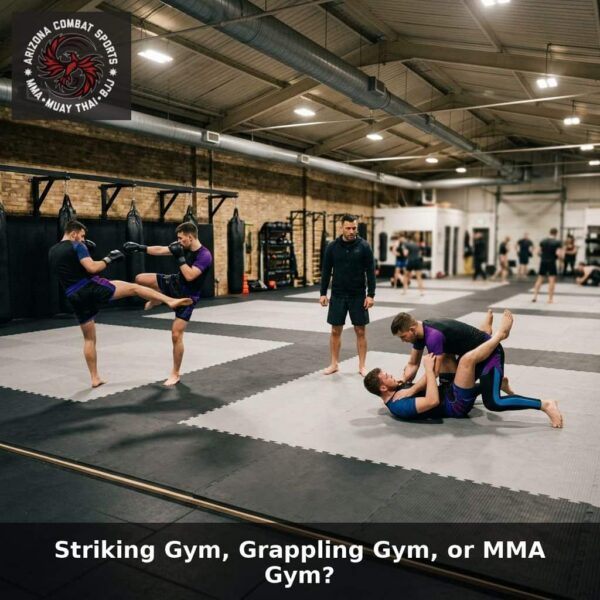
Arizona’s martial arts scene broadly splits into three categories. Striking-focused gyms teach disciplines like boxing, Muay Thai, and kickboxing, all of which develop skills from standing range. Grappling-focused gyms teach Brazilian jiu-jitsu, wrestling, or submission grappling, where the goal is controlling and submitting an opponent on the ground. Integrated MMA gyms teach all three combat ranges, including standing, clinch, and ground, as a unified system rather than separate sports stacked on top of each other.
The core difference is not which gym has better coaches. It’s whether the curriculum treats combat as one continuous problem or as isolated skill sets.
Should Beginners Start With Striking or Grappling Before MMA?
This is one of the most common questions beginners ask. The honest answer: you don’t have to pick one first. Many instructors say that starting with a specialist background builds a sharper foundation in one area, and that’s true. But the tradeoff is time. Spending a year at a boxing gym and then a year at a BJJ school before you start mixing them means you’re spending two years developing habits that eventually need to be re-wired for transitions between ranges.
If your target is MMA or general self-defense readiness, starting in an integrated program from day one means your striking, clinch, and ground skills develop simultaneously, and your nervous system learns to connect them from the beginning rather than re-learn that connection later.
What a Striking-Focused Gym Actually Teaches (And What It Leaves Out)
What You Learn: Standup Range, Footwork, and Striking Combinations
Striking gyms, whether they focus on boxing, Muay Thai, or kickboxing, build real, meaningful skills. You’ll develop hand combinations, head movement, footwork, timing, and defensive technique at standing range. Muay Thai schools add elbows, knees, and basic clinch striking. Boxing gyms drill punching accuracy and ring generalship. These are legitimate, battle-tested disciplines with deep competitive histories.
For fitness, coordination, and standup confidence, a striking gym delivers. Many people train at them for years and become genuinely dangerous at standing range.
The Gap: Clinch Control and Ground Grappling
Here’s what striking-only programs typically don’t teach: what to do when the fight closes to clinch range and neither person wants to stand and trade, and what to do if the fight goes to the ground. Clinch control, takedown defense, takedown offense, positional grappling, and submission defense are all skills that require dedicated mat time, and most striking-focused gyms don’t include them systematically.
In a real self-defense situation or an MMA competition, a striker who has never trained clinch work or ground grappling is in unfamiliar territory the moment an opponent closes distance. That gap isn’t theoretical. It’s one of the most documented patterns in early MMA competition: skilled strikers struggling the moment fights hit the mat.
Injury risk also shifts at striking gyms. Sparring involves real impact to the head and body, so concussion risk and cumulative head trauma are legitimate concerns to ask any striking gym about before you sign up. Ask how frequently contact sparring happens, whether protective gear is mandatory, and how coaches manage intensity for beginners.
What a Grappling-Focused Gym Actually Teaches (And What It Leaves Out)
What You Learn: Ground Control, Submissions, and Takedowns
Grappling gyms, particularly those focused on Brazilian jiu-jitsu or wrestling, teach a completely different skill set. You’ll learn how to take an opponent to the ground, control their body, defend submissions, and apply your own. BJJ programs typically cover positional hierarchy, guard play, sweeps, and a wide variety of chokes and joint locks. Wrestling programs emphasize explosive takedowns, top pressure, and scramble defense.
These skills translate directly into MMA and self-defense. Someone with a solid grappling base can control where a fight happens, which is a genuine tactical advantage.
The Gap: Standup Striking and Clinch Entry
What grappling-only programs typically skip is everything that happens before the clinch. You won’t develop boxing defense, striking counters, or the ability to read and time a punching exchange. More practically, you won’t drill how to close the distance safely from striking range, because pure grappling programs start from clinch or ground by default.
In an MMA context, a grappler who can’t safely enter the clinch against a striker has a problem. They know exactly what to do once they get there, but getting there safely requires standup skills the grappling gym didn’t develop.
Injury patterns at grappling gyms skew toward joint and orthopedic issues: shoulder, knee, and elbow injuries are common with heavy live rolling. Before joining any grappling gym, ask how coaches manage rolling intensity for new members and what the culture looks like around tapping early and respecting joint locks.
How an Integrated MMA Curriculum Closes the Gaps Between Disciplines
Teaching All Three Ranges as One Connected System
An integrated MMA program teaches striking, clinch work, and ground grappling as parts of one continuous skill set rather than three separate sports. A well-designed MMA class doesn’t spend 20 minutes on boxing, then stop and restart with a BJJ drill. It builds transitions: how your striking position sets up a clinch entry, how clinch work leads to takedowns or walls, how takedowns connect to ground control and finish attempts.
Arizona Combat Sports structures its MMA classes to cover every range of combat, so members build confidence standing, in the clinch, and on the ground inside the same training environment. That continuity matters. When your body learns the transitions repeatedly, range-switching under pressure becomes instinct rather than a deliberate choice.
What Switching to an All-Ranges Gym Actually Costs You (And Doesn’t)
A common concern for people coming from a specialist background is that switching to an integrated program means starting over. It doesn’t. Existing striking or grappling experience carries directly into MMA training. Someone with three years of boxing brings real head movement, footwork, and timing. Someone with a wrestling background brings genuine takedown ability and top control. An integrated program adds the ranges they haven’t developed yet, it doesn’t erase what they already have.
Cost is another practical factor. Monthly rates at martial arts gyms in Arizona vary widely depending on facility, location, and program depth. A specialist gym might seem more affordable on paper, but if your goal is all-ranges training, you may end up paying for two or three separate memberships to cover striking, grappling, and clinch. A single integrated MMA membership often costs less in total than multiple specialist memberships combined.
Timeline expectations are also worth setting honestly. Most coaches will tell you that 6 to 12 months of consistent training in an integrated MMA program is enough for a beginner to feel functional across all three ranges. That doesn’t mean competitive-ready; it means you’re no longer a complete beginner in any single range.
Choosing the Right Training Path for Your Goals in Arizona
Matching Your Training Goal to the Right Gym Type
If you want to compete in a specific combat sport, a specialist gym often makes sense. A boxer preparing for amateur boxing does not need BJJ. A competitive jiu-jitsu athlete focused on IBJJF competition doesn’t need striking. Specialist training for specialist competition is a logical match.
If your goals are broader, including MMA competition, general self-defense preparedness, or simply becoming a well-rounded martial artist, an integrated program is the more efficient path. You’re not sacrificing depth for breadth. A good MMA program goes deep in all three ranges; it just doesn’t treat them as independent sports.
Arizona has a strong martial arts community across Phoenix, Scottsdale, Tucson, and the surrounding areas. That means real options exist. The question to ask any gym is not just “do you teach MMA?” but whether that MMA curriculum genuinely integrates striking, clinch, and ground work inside the same class structure.
Questions to Ask Any Gym Before You Join
Before signing up anywhere, use these questions to test whether an MMA program is truly integrated:
- Are striking, clinch, and ground grappling taught together within the MMA class itself, or are they separate classes you have to stack?
- Does the curriculum include transitions between ranges, or does each class focus on one range at a time?
- How does the program handle beginners who come in with a striking background? With a grappling background? With no background at all?
- What’s the sparring culture? Is contact intensity managed by coaches, or is it primarily student-driven?
- Is there a clear progression structure, so you know how your skill set is supposed to develop over the first 6-12 months?
A gym that can answer all five questions with specifics is a gym that has actually thought through its curriculum rather than just marketing the MMA label.
Frequently Asked Questions About Striking vs Grappling MMA Gym
Sources
- Overview of combat sports disciplines and training methodologies: Wikipedia, “Mixed Martial Arts”, https://en.wikipedia.org/wiki/Mixed_martial_arts
- Brazilian jiu-jitsu background and competition structure: Wikipedia, “Brazilian jiu-jitsu”, https://en.wikipedia.org/wiki/Brazilian_jiu-jitsu
- Muay Thai training and standup striking tradition: Wikipedia, “Muay Thai”, https://en.wikipedia.org/wiki/Muay_Thai
- General concussion and head impact risk in combat sports: Centers for Disease Control and Prevention (CDC), “Concussion in Sports”, https://www.cdc.gov/headsup/sports/index.html
25+ Years in Tempe
Why Trust AZ Combat Sports
For more than 25 years, Arizona Combat Sports has trained complete beginners, kids, ASU students, first responders and professional fighters at one location: 1425 West 14th Street in Tempe. Here's what has kept the East Valley coming back.
-
Founded & Run by Fighters
Founded by Trevor Lally and led today by partners who have competed at a high level, including former pro fighter and MMA head coach Trevor Smith.
-
Black Belt Instruction
BJJ head coach Steve Rosenberg is a second-degree black belt under Nova União and has coached at ACS for more than 15 years.
-
Proven With Competitors
An active fight team of amateur and pro athletes, with students competing in IBJJF tournaments, submission-only events and MMA.
-
Safety First, Always
Every class is supervised, sparring is always optional, mats are sanitized multiple times a day, and youth instructors are background-checked.
-
Zero-Ego Culture
Beginners train next to experienced fighters in a team-first room. Most members walk in with no martial arts background at all.
-
No Contracts, No Surprises
Month-to-month memberships with no sign-up fees. Try one free class per discipline before you commit to anything.
"I've trained at this gym for four years doing BJJ and I can't recommend it enough."
Anthony, Google review of Arizona Combat Sports