
Key Takeaways:
- Submission wrestling (no-gi grappling) builds real functional fitness and self-defense skills without requiring any prior martial arts experience.
- Classes at Arizona Combat Sports serve everyone from complete beginners to competitive fighters, with flexible scheduling throughout the week.
- Try your first class to experience the training firsthand; no gear required to get started.
Most people who walk through the door for their first no-gi class expect to feel lost. What they actually feel, after the sweat dries, is something closer to addicted.
Submission wrestling is one of the fastest-growing combat sports in 2026, and for good reason. It builds genuine full-body fitness, sharpens mental focus, and teaches practical self-defense skills that work in the real world. You don’t need a uniform. You don’t need prior experience. You just need to show up.
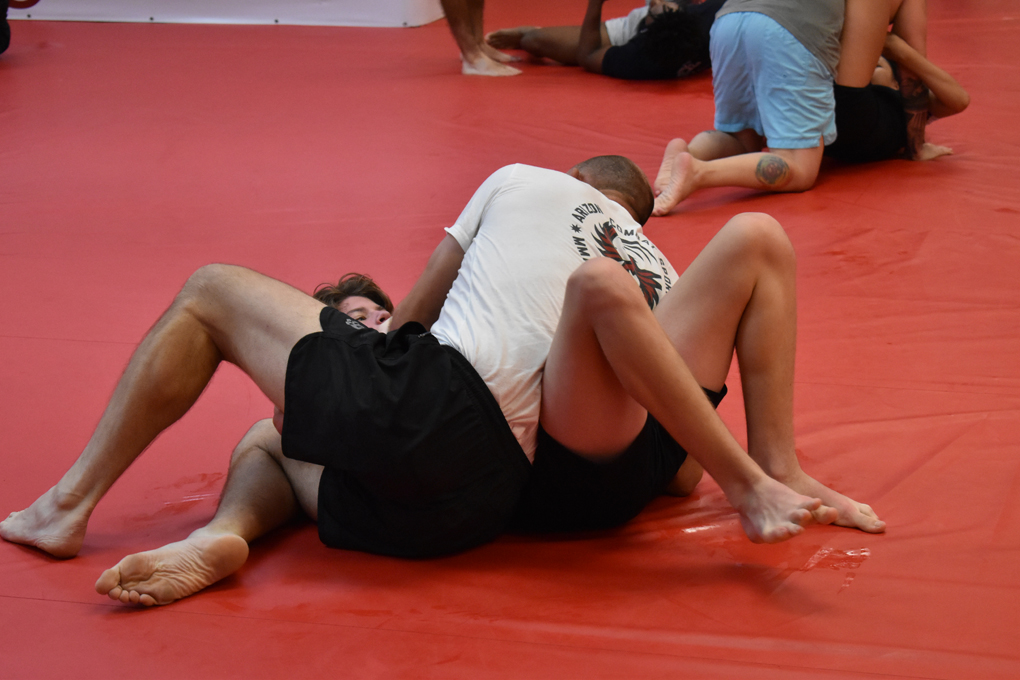
At Arizona Combat Sports, our submission wrestling program blends wrestling-based takedowns with Brazilian Jiu-Jitsu submission mechanics, all without the gi. The result is a faster, more athletic style of grappling that translates directly to MMA competition, self-defense, and everyday fitness goals.
What Is Submission Wrestling and How Is It Different from BJJ or Regular Wrestling?
Submission wrestling combines takedowns, positional control, and submission holds into one complete grappling system. It sits between traditional wrestling and Brazilian Jiu-Jitsu.
How No-Gi Grappling Differs from Gi BJJ
In gi BJJ, practitioners wear a heavy cotton uniform that creates friction and additional grip points: collar chokes, lapel guards, sleeve grips. No-gi removes all of that. You wear shorts and a rash guard, and so does your training partner. Every grip must come from body control: underhooks, wrist ties, head control, and body locks.
The pace is noticeably faster. Scrambles happen more often. Transitions between positions require sharper reflexes and greater athleticism. Many gi practitioners find that adding no-gi training dramatically improves their overall game, because they can no longer rely on friction to slow things down.
No-Gi vs. MMA Grappling
MMA grappling operates inside submission wrestling’s framework but adds the context of strikes and a cage or ring. Submission wrestling trains the pure ground-and-clinch skill set that MMA fighters depend on. Practicing in a controlled no-gi environment lets fighters drill takedowns and submissions at full intensity without the added variable of punches and kicks.
Why Choose No-Gi Submission Wrestling?
No-Gi Submission Wrestling has become one of the most dynamic and competitive forms of grappling worldwide. It’s the style favored in prestigious events like ADCC (Abu Dhabi Combat Club), EBI (Eddie Bravo Invitational), and countless MMA promotions. Without a Gi to slow the pace, every movement is faster, every scramble more intense, and every transition more critical.
This fast-paced nature makes No-Gi invaluable for realistic self-defense situations, where opponents don’t wear uniforms or offer grips. Students quickly learn body control, leverage, and submission setups that work under pressure. Training this way also builds endurance, explosiveness, and timing, ensuring you can perform at your best even during the most challenging rounds.
At AZ Combat Sports, we’ve designed a curriculum that balances fundamentals with cutting-edge competition techniques, giving every student—from beginner to pro—the tools they need to succeed.
What You’ll Learn in Submission Wrestling (No-Gi Grappling)
Our No-Gi Submission Wrestling program is built for all levels—from first-time grapplers to advanced competitors.
Key Techniques in No-Gi Submission Wrestling
By layering drilling, situational sparring, and live rounds, our classes ensure you not only understand techniques but also know how to apply them under pressure.
Submission Wrestling for MMA and Self-Defense
For fighters entering MMA, No-Gi grappling is a non-negotiable skill set. Most professional bouts are decided on the ground, and learning how to maintain control, escape bad positions, or secure submissions can be the difference between victory and defeat.
Beyond the cage, Submission Wrestling is also a highly effective tool for practical self-defense. Since there are no uniforms in real-life encounters, No-Gi’s reliance on underhooks, body locks, and clinch work makes it directly applicable. Students gain confidence knowing they can protect themselves without depending on clothing grips.
At AZ Combat Sports, we train you not only to submit opponents but also to defend yourself intelligently, avoiding unnecessary risks while staying in control.
What Sets Our Submission Wrestling Training Apart?


Who Should Train in Submission Wrestling?
Our program attracts a diverse group of students, each with their own goals. You’ll fit right in if you are:
- An MMA fighter seeking to sharpen ground skills for cage competition
- A BJJ student wanting to adapt to the No-Gi style for tournaments
- A wrestler looking to expand into submission grappling
- A beginner building self-defense, confidence, and fitness
- A hobbyist who wants an intense, challenging, but enjoyable workout
No matter your background, our instructors will guide you step by step, helping you build the skills you need to succeed.
Physical & Mental Benefits of No-Gi Grappling
Beyond techniques and competition, Submission Wrestling offers a host of benefits:
- Strength & Conditioning: Grappling builds functional strength, grip power, and endurance.
- Flexibility & Mobility: Regular training improves range of motion and injury resistance.
- Problem-Solving Under Pressure: Every roll is a mental chess match, sharpening focus and decision-making.
- Stress Relief: Training pushes you into the present moment, reducing stress and improving overall well-being.
- Community & Support: The mats become a second home where teammates encourage and challenge you.
Class Structure & Schedule
At AZ Combat Sports, we make it easy to commit to your training by offering classes multiple times per week, including evenings and weekends. This flexible schedule allows students of all ages and lifestyles to stay consistent, whether you’re a working professional, a student, or a competitive athlete. Each session is designed to maximize your time on the mats while balancing technical growth, conditioning, and live application.
Warm-Up & Mobility
Every class begins with a structured warm-up designed to prepare both body and mind for the work ahead. Mobility drills target the hips, shoulders, and spine—critical areas for grappling performance and injury prevention. Dynamic movements such as sprawls, shrimping, and penetration steps not only build muscle memory but also mimic the exact motions you’ll use in live training. This approach ensures your body is ready for explosive takedowns, scrambles, and submission attempts while reducing the risk of strains and fatigue.
Technical Instruction
Once the body is primed, we shift into focused technical instruction. Coaches break down core techniques step by step, from takedown setups to advanced submission chains, ensuring students at every level can understand and apply them. Beginners receive clear, fundamental instruction, while advanced grapplers are given deeper insights into timing, grip variations, and strategic adjustments. Each lesson ties into a broader curriculum, so techniques build on one another, creating a well-rounded game plan that grows with you over time.
Positional Drilling
After learning the technique, students move into positional drilling to reinforce the day’s lesson. These controlled, scenario-based drills allow you to practice specific positions—like escaping mount, defending leg locks, or attacking from side control—under measured resistance. This type of training bridges the gap between theory and live application, sharpening your ability to think strategically and respond under pressure. It also develops muscle memory, making your reactions instinctive during live rolling or competition.
Live Sparring (Rolling)
The final portion of class is dedicated to live sparring, where students test their skills in real-time grappling rounds. Rounds are timed and structured, with partners rotating to ensure variety and challenge. Live sparring gives you the opportunity to apply techniques, experiment with strategies, and adapt against fully resisting opponents. Safety is always a priority—coaches monitor every round to maintain control and offer feedback. This environment helps you build confidence, resilience, and the ability to stay calm while problem-solving under pressure.
Additional Training Opportunities
Beyond the standard class structure, AZ Combat Sports also offers open mat sessions, competition prep classes, and specialized workshops. Open mats provide a more relaxed environment for drilling or sparring with different partners, while competition prep sharpens your mental and physical readiness for tournaments. Workshops dive deep into specific areas such as leg lock systems, wrestling integration, or submission chaining, giving students the chance to refine specialized skills.
Start Submission Wrestling at AZ Combat Sports
No-Gi Submission Wrestling at AZ Combat Sports is more than just training—it’s a pathway to discipline, resilience, and mastery. Whether your sights are set on ADCC-level competition, your first amateur MMA fight, or simply becoming stronger and more confident, this program will elevate your game.
The best way to experience it is to step on the mats yourself. Take your first class today and see why AZ Combat Sports is the home of champions in Arizona.
Start your No-Gi journey today. Your future self will thank you.
FAQs About Submission Wrestling (No-Gi Grappling)
What is submission wrestling and how is it different from regular wrestling or BJJ?
Submission wrestling combines wrestling-style takedowns with the submission holds of BJJ, practiced without a gi uniform. Regular wrestling focuses on takedowns and control without submissions. Gi BJJ uses a cotton uniform that creates grip points and slows the pace. No-gi grappling removes the uniform, makes the game faster and more athletic, and sits directly between those two sports.
Are there submission wrestling and no-gi grappling classes near Mesa, Chandler, Gilbert, Scottsdale, Tempe, and Phoenix?
Yes. Arizona Combat Sports serves grapplers throughout the East Valley and greater Phoenix metro, with class times that work for working adults and competitive athletes alike. The gym is centrally located for students coming from Mesa, Chandler, Gilbert, Scottsdale, and Tempe.
How much do submission wrestling or no-gi grappling classes cost per month in the Phoenix area?
Pricing depends on the membership tier and class frequency you choose. Contact Arizona Combat Sports directly for current monthly rates, drop-in pricing, and any introductory offers. Many gyms in the Phoenix area price martial arts memberships competitively with standard gym memberships, especially considering the coaching and community you receive.
Is no-gi grappling good for fitness, or is it mainly for fighters?
No-gi grappling is an excellent full-body workout for anyone. A single class combines cardiovascular conditioning, explosive strength, flexibility, and mental focus. Many students join with zero interest in competition and train purely for fitness, stress relief, and community. The sport rewards consistency regardless of athletic background.
How long does it take to get good at submission wrestling as a beginner?
Most beginners see noticeable improvement within three to six months of regular training. You’ll start recognizing positions, escaping common traps, and applying basic submissions. Reaching a competitive level typically takes one to three years. Training three or more times per week accelerates progress .
What should a complete beginner expect in their first submission wrestling class?
Expect a warm-up with mobility drills and movement patterns, followed by step-by-step technical instruction. Most gyms pair beginners with experienced, patient training partners. Live sparring at the end of class typically starts with positional drilling rather than full submissions so new students can build comfort and confidence gradually.
Is submission wrestling safe for adults with no prior martial arts experience?
Yes, with proper precautions. Reputable gyms manage risk through progressive drilling, thoughtful partner pairing, and a culture where tapping early is respected. Bumps and soreness are normal in any physical sport. The key is choosing a gym with experienced coaching and a community that prioritizes long-term training over short-term ego.
What gear and equipment do you need for no-gi grappling classes?
You need athletic shorts (no pockets or belt loops), a rash guard or fitted athletic shirt, and a mouthguard. Many beginners start their first session in basic workout clothes while they evaluate the sport. Some gyms also recommend ear guards for extended training. Ask the gym what they recommend before your first class.
What is the difference between no-gi BJJ, submission wrestling, and MMA grappling?
No-gi BJJ applies BJJ concepts and rules without the gi uniform. Submission wrestling is a broader term covering any grappling with submissions, often with rules from organizations like ADCC. MMA grappling applies these skills inside a mixed martial arts context that includes strikes and a cage or ring. All three share significant overlap in techniques and concepts.
Should beginners start with submission wrestling or gi BJJ?
Either is a valid starting point. Gi BJJ slows the game down, which some beginners find helpful for absorbing concepts. No-gi moves faster and applies more directly to self-defense and MMA. Many students in the Phoenix area train both. If your primary goals are MMA competition or real-world self-defense, starting no-gi makes practical sense.
Are there alternatives to submission wrestling for adults who want a full-body workout in the Phoenix area?
Yes. Boxing, Muay Thai kickboxing, traditional wrestling, and gi BJJ all offer excellent full-body conditioning. Yoga and CrossFit serve fitness goals without the combat sports context. That said, submission wrestling combines strength, cardio, flexibility, and mental challenge in a single training session in a way that most gym-based alternatives don’t replicate. It’s worth trying at least once before ruling it out.
Sources
- Submission wrestling, definition and overview: Wikipedia, https://en.wikipedia.org/wiki/Submission_wrestling
25+ Years in Tempe
Why Trust AZ Combat Sports
For more than 25 years, Arizona Combat Sports has trained complete beginners, kids, ASU students, first responders and professional fighters at one location: 1425 West 14th Street in Tempe. Here's what has kept the East Valley coming back.
-
Founded & Run by Fighters
Founded by Trevor Lally and led today by partners who have competed at a high level, including former pro fighter and MMA head coach Trevor Smith.
-
Black Belt Instruction
BJJ head coach Steve Rosenberg is a second-degree black belt under Nova União and has coached at ACS for more than 15 years.
-
Proven With Competitors
An active fight team of amateur and pro athletes, with students competing in IBJJF tournaments, submission-only events and MMA.
-
Safety First, Always
Every class is supervised, sparring is always optional, mats are sanitized multiple times a day, and youth instructors are background-checked.
-
Zero-Ego Culture
Beginners train next to experienced fighters in a team-first room. Most members walk in with no martial arts background at all.
-
No Contracts, No Surprises
Month-to-month memberships with no sign-up fees. Try one free class per discipline before you commit to anything.
"I've trained at this gym for four years doing BJJ and I can't recommend it enough."
Anthony, Google review of Arizona Combat Sports